

Beyond Contrafact, Part 1
Changing the Changes

Beyond Contrafact part 1
In the early period of my music writing I studied with George Russell and was particularly intrigued by his seminal book, The Lydian Chromatic Concept (LCC). While it never replaced the traditional diatonic relationship of chords and scales for me, it provided a prism that refracted the possibility of a huge number of other systems that could exist alongside, and often parallel to, the major scale, its modes and the harmonies they produce.
As an exercise in reharmonization I would take a standard tune or even a tune by a great jazz composer like Wayne Shorter and would go as far as possible in creating a new harmony, using my own interpretation of the LLC’s method for substituting chords.
A contrafact, at least as far as jazz is concerned, consists of a previously used harmonic basis, often that of a standard tune, with an entirely new melody written over it. This was common during the bebop period so musicians could improvise over familiar chord changes while getting credit for a new composition.
Here is one of my methods for substituting chords, influenced by LCC, years of experience on the bandstand as a jazz musician and by my own compositional practices.
A chord is closest to, and can be substituted by, any other chord from the same modal system. An Fmaj7(#11) is from the C major scale, so it is closest to all the other chords in C major: Cmaj7(9,11,13), Dm7(9,11,13), Em7(b9,11,b13), G7(9,11,13), Am7(9,11,b13) and Bm7b5(b9,11,b13).
The next closest chords would come from parallel heptatonic modal systems.
C melodic minor: Cm(maj7)(9,11,13), Dm7(b9,11,13), Ebmaj7#5(9,#11,13), F7(9,#11,13), G7(9,11,b13), Am7b5(9,11,b13) and Bm7b5(b9,b11,b13) which is more commonly viewed enharmonically as B7b5(b9,#9,b13) or B7#5(b9,#9,#11) or simply as B7alt.
C harmonic minor: Cm(maj7)(9,11,b13), Dm7b5(b9,11,13), Ebmaj7#5(9,11,13), Fm7(9,#11,13), G7(b9,11,b13), Abma7(#9,#11,13) and Bo7(b9,b11,b13).
C harmonic major: Cmaj7(9,11,b13), Dm7b5(9,11,13), Em7(9,b11,13), Fm(maj7)(9,#11,13), G7(b9,11,13), Abma7#5(#9,#11,13) and Bo7(b9,11,b13).
See my book Harmonic Landscapes for the additional parallel Heptatonic Systems, including major b2 and double harmonic (which is major b2, b6) and numerous others.
The next closest chords would come from modal systems either a fourth or a fifth away. For Fma7(#11), emanating from Cmajor they would be F major and G major and all their respective parallel heptatonic modal systems.
We also need to extend this process to chords derived from symmetrical scales.
Let’s say a C7(b9) is from a half/whole symmetrical diminished scale. The closest chord to use for substitution would be the dominant 7th derived from the same scale. For a B7(b9) it is F7(b9,#9,#11,13), D7(b9,#9,#11,13) and Ab7(b9,#9,#11,13).
If we associate a G7#5 with a whole tone scale, its closest chords to use for substitution are chords of the same quality in a series of whole tones that would include G: A7#5(9,#11), B7#5(9,#11), C#7#5(9,#11), D#7#5(9,#11) and F7#5(9,#11).
For Chords derived from the symmetrical augmented scale there is a circle of major thirds for substitution. If the chord is Bbmaj7#5 and its from symmetrical augmented, the closest chords for substitution would be Dmaj7#5 and F#maj7#5. However, due to the structure of the symmetrical augmented scale you simultaneously have chords from the same roots but with different qualities. So along with maj7#5 chords from three chords a major third apart there is also, in the case of Bbmaj7#5, Bbmaj7, Bbm(maj7), Dmaj7, Dm(maj7), F#maj7 and F#m(maj7).
There are numerous additional harmonic systems, including Messiaen’s modes of limited transposition, for which we can devise substitution possibilities. We will look at those possibilities elsewhere. Let’s now put some of this into practice.
Fall
By substituting all the chords in an existing harmonic structure of an already existing tune we are able to absorb and extend its harmonic logic and we then grasp more deeply the trajectory of form.
Fall is a 16 bar tune by Wayne Shorter, one of the greatest composers for improvisers from the jazz tradition. Even in its mere 16 bars there is clearly an AABA form.
Here is a version of the original chord changes -
C#m11 / B7(b9) / E7(sus4) / Cm13 /
C#m11 / B7(b9) / E7(sus4) / Cm13 /
Dmaj7 / D13(b9) / Gm7 / Bm9 Abmaj7(#11) /
F#7(sus4) / B7 / Em7 Cmaj7(#11) / Cmaj7(#11) //
The first chord, C#m11 is a II chord in B major. Let’s limit ourselves to a substitution from this scale/harmonic system for this first chord. Out of the six remaining possibilities, we’ll choose the IV chord, Emaj7(#11) and use the #11 to emphasize its character as a lydian sound.
For the second chord, B7(b9), we’ll assume is from symmetrical diminished, so the possible substitutions are F7, Ab7 and D7 with any of these upper voices: b9,#9,#11 and 13. Let’s pick F13(b9).
The third chord is E7(sus4), a V chord in A major. For this we will use the VI chord in A major, F#m7(b13), with b13 added to emphasize its aeolian sound.
Cm13 is the fourth chord in this progression and it’s a II chord in Bb major. We will also use the IV chord as the substitute, but this time in Bb major.
Our new first four bars now look like this:
Emaj7(#11) / F13(b9) / F#m7(b13) / Ebmaj7(#11) /
The next four bars are identical, but we will use different possibilities for substitution.
Using the same process, here are possible results:
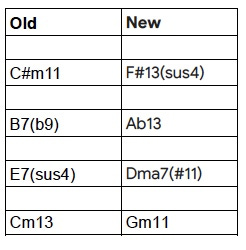
We have different chords in the B section (third group of four bars), so we keep the process going.
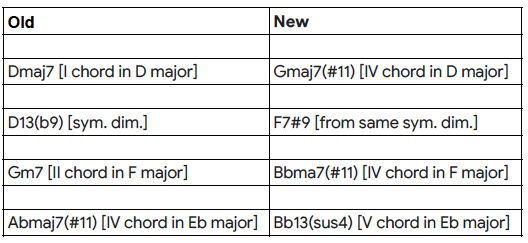
And the final four bars are a repeat of the A section slightly altered.
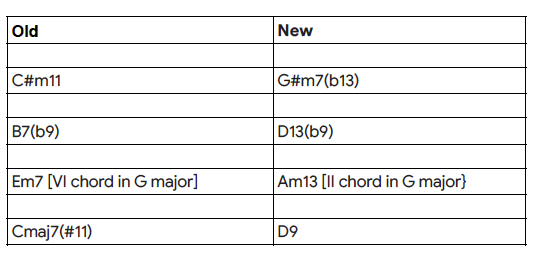
Emaj7(#11) / F13(b9) / F#m7(b13) / Ebmaj7(#11) /
F#m13(sus4) / Ab13 / Dmaj7(#11) / Gm11 /
Gmaj7(#11) / F7(#9) / Bbmaj7(#11) /Dmaj7(#11) Bb13(sus4) /
G#m7(b13) / D13(b9) / Am13 D9 / D9 //
As we look at the new changes and hear each chord progress from one to the next, it still has a flavor of the original progression. There is a familiarity to the harmonic gravity, but the shading of the colors is somewhat different.
The next step would be to make the chords connect with each other in progression. Without actually notating and voicing the chords, let’s voice lead the bass using chord symbols.
Emaj7(#11) 〳 F13(b9)/Eb 〳 F#m7(b13)/E 〳 Ebmaj7(#11) 〳
F#m13(sus4)/E 〳Ab13/Gb 〳 Dmaj7(#11)/F# 〳 Gm11 〳
Gmaj7(#11) 〳 F/Ab 〳 Bbmaj7(#11) 〳 D/G# Bb13(sus4)/Ab 〳
G#m7(b13) 〳 D/F 〳 Am/D D/E 〳D/E 〳〳
Continued next installment
I am planning on publishing all of my compositions here and much more content when, sometime in the future, I institute paid subscriptions. Material will still be available for free subscribers, similar in scope to what has already been coming out.
Copyright © 2023 Jack DeSalvo