

Bramosia Part 1
Investigating a piece from the album Breaking The Dragon.


The remarkable pianist and composer Chris Forbes and I (on various guitars) recorded a duo album for Unseen Rain Records featuring compositions from both of us. Bramosia is a track that I wrote, so we will look closely at this piece, particularly the harmony.
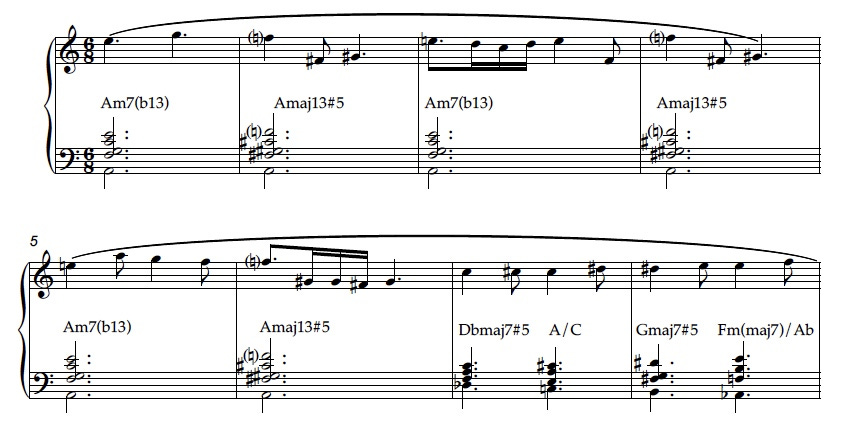
The first 6 bars of the initial 8 measure section features two alternating chords. One way they can be viewed is as two chords shifting back and forth over an A pedal tone. I did not view them that way, though ultimately I named them with A as the root of both chords.
Taking the A bass note out of the picture we have two slash chords a half step apart. The chord at the first, third and fifth measure (again sans the A bass note) is a C triad over its 4th which would be written C/F and the chord of the second. fourth and sixth measures would be a Dd triad over its 4th, a Gb - Db/Gb. Placing these two chords without the additional A bass notes just gives the effect of the same harmonic colors moving up or down a half step.
Now the additional bass note A profoundly changes the colors of each chord transforming their meaning and role in the music. From the A they expand into 13th chords with Am7(b13) creating a distinctive aeolian atmosphere juxtaposed to the utterly different sonority of the Amaj13#5. With Amaj13#5 we have a particularly bright harmony, suggesting the lydian #5 ambiance.
These is also the simultaneous half step movement of the C triad to the Db triad, then the slash chords, C/F which can evoke the sound of an Fmaj9(no3) which in turn can be heard as a and the Db/Gb can be a Gbmaj9(no3).
The transforming role of the shared bass note A makes all the voices above it in both chords sound like they are deeply connected to it, the A being truly rooted in an almost chthonic sense with the additional voices from both chords emanating from it.
The seventh and eighth measures contain two chords each, which can be seen as triads, or at least three note structures over different bass notes. Since maj7#5 chords naturally occur on the b3rd degree of melodic minor, and harmonic minor for that matter, it makes sense to name them as such. It’s also important to note that Dbmaj7#5 is also F/Db, and depending on the inversion the ear can hear it that way also.
The next chord A/C is an A triad with its #2 (or #9) in the bass and in the eighth measure Gmaj7#5 (or B/G) and Fm(maj7)/Ab. So we can now see, sans the bass notes except in the case of the Fm(maj7)/Ab from which we’ll extract the Fm triad, triadic movement: F, A, B, Fm.
Now look at the bass movement alone, Db, C, G, Ab. The triads ascend while the bass notes descend. And of course the combination of these triads and their respective bass notes again creates a completely different atmosphere than the triads alone.
The melody comes directly out of the harmony while following a linear trajectory.
You can here the entire track here:
We will continue with this piece next time.
As I mentioned earlier, I am planning on publishing all of my compositions here and much more content when, sometime in the future, I institute paid subscriptions.
Meanwhile, please subscribe.
Material will still be available for free subscribers, similar in scope to what has already been coming out.
Copyright © 2024 Jack DeSalvo