

Bramosia Part 2
Continued Investigations into this piece from the Unseen Rain Records album Breaking The Dragon

Listen to entire track in the above player.
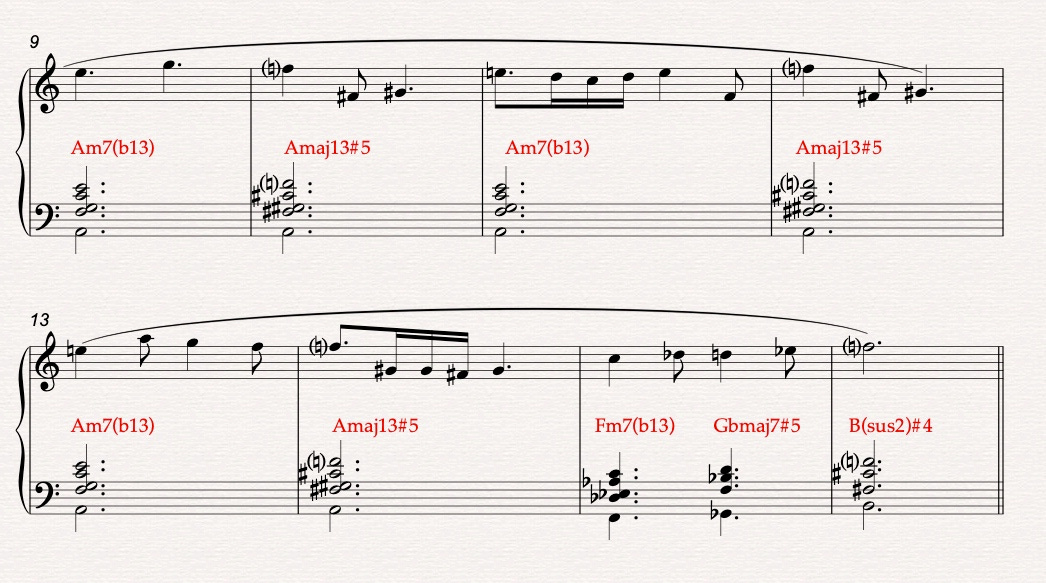
Above that are measures 9 through 16. As we can see, 9 through 14 contain the same alternating harmonies Am7(b5) and Amaj13#5 as bars 1-6 that we saw in Part 1. In measures 15 and 16 there are new structures, Fm7(b13), Gbmaj7#5 and B(sus2)#4.
Looking at Fm7(b13), the voicing, from low to high is Root, b13, b7,b3 and 5. This is essentially the same intervallic structure as the opening chord Am7(b13), but transposed up a minor 6th. This was not, however, how I came to the new chord.
Harmonies are essentially sonic atmospheres. The C# major triad, enharmonically a Db major triad with Ab, Db and F, that constitutes the upper three tones of the Amaj13#5, becomes the sonic basis of the new chord as the notes of the Db triad, which are within the Fm7(b13). Db being the b13, F the root and Ab the b3. In fact an alternate view of the Fm7(b13) could be with Db as root as a Dbmaj9/F.
In the same measure we have Gbmaj7#5, moving the bass up a half step and revealing its alternate identity as a Bb major triad with a Gb in the bass. Most of the time I prefer identifying it as a maj7#5 because we see its origin as the chord built on the b3 of melodic minor. The thing is, we can hear this chord coming from a variety of sources. An alternative origin for maj7#5 chords is the symmetrical augmented family of chords.
The hexatonic (six tone) symmetrical augmented scale produces a remarkable amount of chords, many simply stemming from the three tones of an augmented triad. On each of the three tones, let’s say Gb, Bb and D, this scale gives you a major triad, an augmented triad and a minor triad. Add 7ths and you get, from each of these three tones, maj7, maj7#5 and m(maj7). Of course the other three tones of this hexatonic scale provide additional chords.
Please note below, that although some chords are spelled enharmonically in reference to the Gb symmetrical Augmented scale, all chords are made up of tones from the scale:
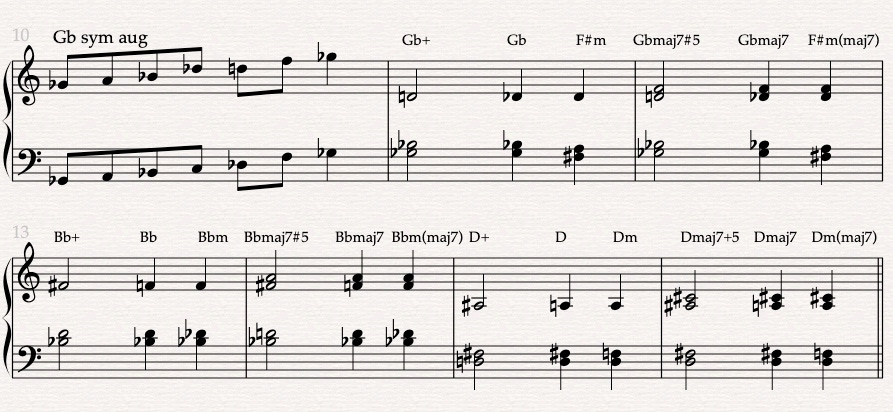
In the case of the Gbmaj7#5 from the composition in question, I heard it as approaching the last chord of this 8 bar section, B(sus2)#4, from two distinct directions. Noting that Gbmaj7#5 is also a Bb major triad with a Gb in the bass, I heard the Bb triad leading into the B♮ chord from a half-step below and the Gb bass note (enharmonically F#) approaching the B bass note as its dominant.
With the final chord of this section, B(sus2)#4, a number of issues appear. First is nomenclature. I have have no intention of completely revising chord symbol language, which has evolved over a very long time. As is, chord symbols represent chords from the simplest C major triad to very sophisticated harmonies, communicating to the player what to expect to hear, or what to play when reading through a chart.
But what I have done, at least in my own work, is to clean up some details and clarify some aspects of chord symbol presentation that is often in contention, particularly as it applies to suspended chords - (sus2), (sus4), etc. and added-note chords - (add2), (add4), etc.
So then, let us consider the next chord B(sus2)#4.
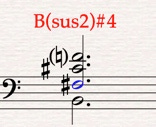
From low to high we have B, F#, C# and F♮, the F♮ being an enharmonic spelling of E#. This is a very interesting structure of two perfect fifths and a major third. This triad, if you will, of two perfect fifths was described by Henry Cowell in his book New Music Resources as being more resonant than a major triad, even one voiced referencing the harmonic series, Root, fifth and third, an intervallic structure of perfect fifth and major six. On our particular voicing of B(sus2)#4, the F♮/E# is a major third added on top of the two perfect fifths, a particularly sonorous structure.
In reference to the nomenclature issues that I alluded to, for the 2nd, 4th and sixth to be considered upper voices, the 7th needs to be present. Regardless of octave placement, a harmony that contains an added 2nd or 4th has a completely different sonic atmosphere when the 7th is not present.
Once more, octave placement is not the determining factor of whether a 2nd is considered the 9th, it’s the presence of a 7th that’s the catalyst.
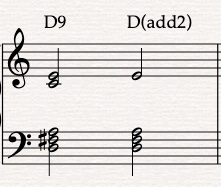
A chord with D as a root, with F#, A and C and with an E added is a D9, because the 7th is present. The same chord without the C (the b7) but with an E added would be a D(add2). In chords with 7ths, the 2,4 and 6 become 9, 11 and 13. You will, on charts, often see chords like D(add9), or even D(9). This, in my opinion, is a confusing misnomer.
Here is an example of the clearest way to emphasize the difference in the substance and sound between a 7th chord with a 2nd added and a triad with a 2nd added. Note that this applies even though the tone (E) is more than an octave above the root.
The chord we are looking at, B(sus2)#4, has the 3rd replaced with the 2nd and the 4, in this case a #4, so it is suspended (sus) because the 3rd is replaced by adjacent tones. They tones are called 2 and #4 because there is no 7th in the chord even though they appear more than an octave above the root.
Let’s also remember that we are discussing music that is written for improvisers. When improvising over the form it is expected that the comping instrument will alter the voicings of the chords so that octave placement will naturally vary.
We will continue analyzing this piece next time with Part 3.
I am planning on publishing all of my compositions here and much more content when, sometime in the future, I institute paid subscriptions.
Meanwhile, please subscribe, it’s still free.
Material will still be available for free subscribers, similar in scope to what I previously published on Substack.
Copyright © 2024 Jack DeSalvo