

Bramosia Part 3
OK, OK, We'll Call It The Bridge

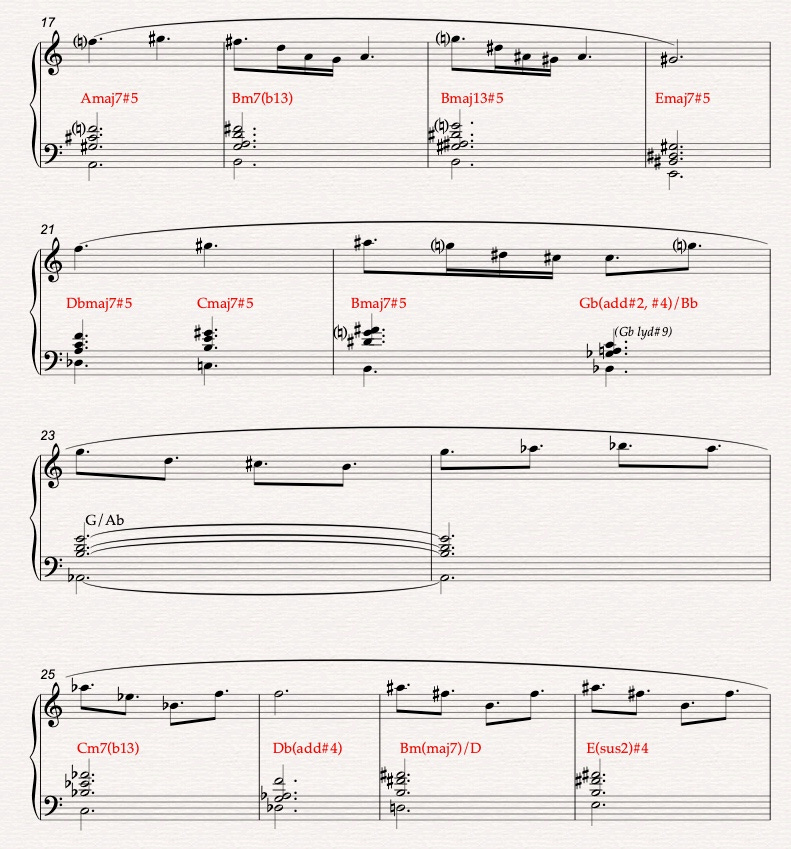
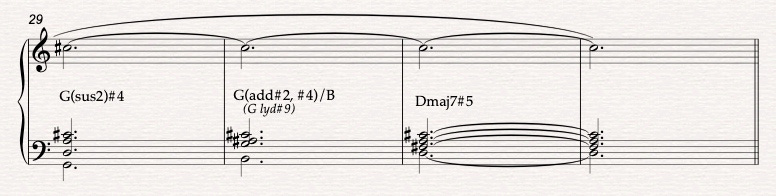
We’ve come to a new section of this piece in our somewhat open ended analysis. Though not designated this way on the chart, it takes the role of a B Section, or “The Bridge”.
It begins with the second chord from the previous section shown in Parts 1 and 2, sans the 13th (F#), so we have an Amaj7#5, voiced in a way that can be interpreted as a C#/A or Db/A. This is parallel voice-led chromatically to a Bm7(b13). While the additional voice, b13 in this case, is brought back, the second inversion C# major triad in the Amaj7#5 chromatically slides up to the second inversion D major triad that’s in the Bm7(b13). The root then moves up a whole step from A to B.
The real discovery with the harmonies in this piece is that they can behave like polychords or bitonal chords yet are mostly derived from a single diatonic, heptatonic or symmetrical source.
While Amaj7#5 contains a number of smaller chords within it, the most distinctive are a C#/Db major triad, three augmented triads - A, C# and F(E#) and an Amaj7(no5). While these chords can suggest a number of linear sources, there can be a single modal source are that covers everything within the harmony. In the case of Amaj7#5, there are two candidates among many that produce this harmony.
The first, if interpreted as written, Amaj7#5, is the third mode of F# melodic minor which is known as the lydian augmented or lydian #5 mode.
You can also easily hear the chord, particularly in the inversion here, as a Db (or C#) major triad with its b6 in the bass - Db/A. This can be derived from a Db harmonic major scale, which is simply a major scale with a b6.
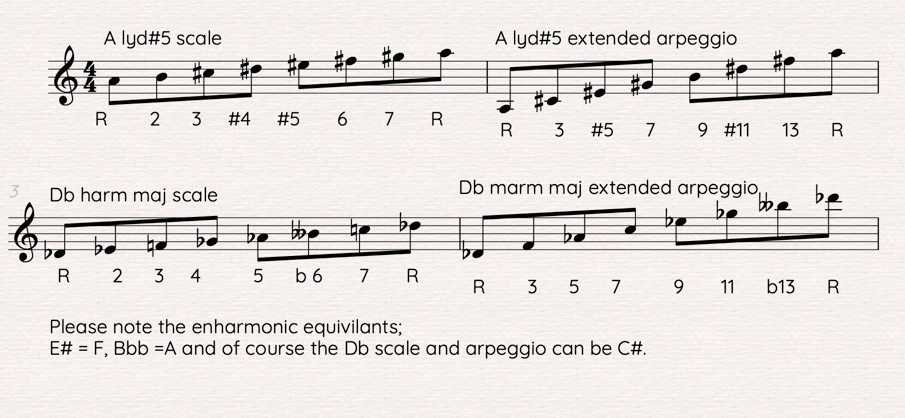
Among other possibilities is a minor 3rd/half step symmetrical augmented scale.
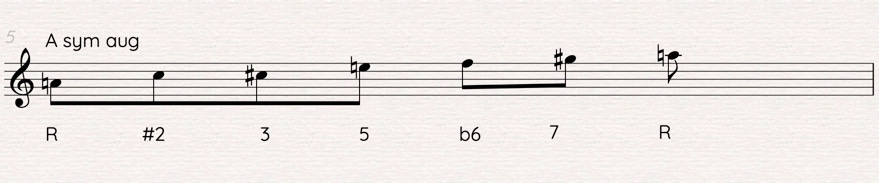
Because the intervallic pattern of the scale is symmetrical there are three possible roots, A, as shown here plus C#(Db) and F (E#).
The third chord in this section is Bmaj13#5. Everything that applied to Amaj7#5 applies here, too, of course a whole step up.
All of this also applies to the following maj7#5 chords, though they have different roots and are voiced differently: Emaj7#5, Dbmaj7#5, Cmaj7#5 and Bmaj7#5.
A particular challenge comes with the next chord, which we are calling Gb(add#2, #4)/Bb. One can easily envision a musician questioning the meaning of this chord designation.
On the chart for, say, a horn player who is more accustomed to simpler, traditional chord symbols it may be wise to write a modal designation to keep the sonic atmosphere consistent while not requiring the improvisor to wrack their brain for solutions.
A Pianist may ask, why not call it Gbo/Bb? While that is a correct description of the chord structure intervallically, it may be even more confusing for the improviser and implies a dominant/symmetrical diminished sonority. My intention was a chord that could potentially have, though not in the given voicing, a major 7. That’s why in similar situations it is crucial to provide the modal designation, in this case Gb lyd#9, to make it clear where this harmony is coming from.
We now come upon two measures of a certain chord, G/Ab. This continues to be a fascinating sonority whatever the voicing/inversion. I believe I first contacted this chord in hearing Icarus by Ralph Towner and around the same time in some of John McLaughlin’s compositions for the Mahavishnu Orchestra, in different keys, of course.
G/Ab, a major triad with a flat 2nd in the bass almost appears as an impossible combination. Most improvisers treat it as a G7(b9), which will work. If you examine the melody over this chord, half step/whole step symmetrical diminished is implied, which would engender not only G/Ab or a G7(b9), but also a myriad of other chords.
The possibilities include major or minor triads with b2, #2, #4 and/or 6 added, dominant sevenths with b9, #9, #11 and 13, all with four possible roots, all within a circle of minor thirds from the original root. Since our original root is G the other possible roots are Bb, Db and E.
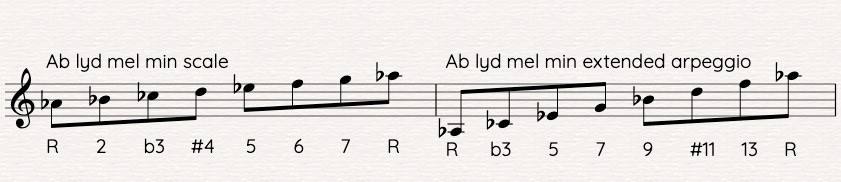
There are surprisingly different ways to interpret G/Ab. It can be heard as an Abm(maj7)#11 from the fourth mode of harmonic major, which in this case would be Ab lydian melodic minor.
Now we look at the final eight bars of this section. With the voicing of Cm7(b13) we see a hidden 3-note structure that is present in the specific voicings in many of the chords in this piece, including Am7(b13), Amaj13#5, Fm7(b13), Bm7(b13), Bmaj13#5 and Cm7(b13).
This 3-note structure intervallically is a major second and perfect fourth, a sus2 triad. In the context of the Cm7(b13) it is Ab, Bb and Eb. These quartal/secundal structures were used by 20th century giants like McCoy Tyner and Igor Stavinsky. By themselves they convey an openness yet have a kind of tensile strength, like the surface of a liquid. When in the context of a larger chord they emit these qualities while affecting the color of the overall harmony.
While a minor seventh chord with a b13 suggests aeolian, the lydian nature of the following chord, a Db major triad with an added #4, Db(add#4), makes the Cm7(b13) sound Phrygian in retrospect.
What follows is a first inversion Bm(maj7) - Bm(maj7)/D, which, by virtue of its voicing in this context sounds like D6#5, which is like the maj13#5 chords in this piece, minus the major seventh.
Next is E(sus2)#4, an E lydian sonority that shares all of its contents and intervallic shape with Bm(maj7)/D, save its bass note E, which is a whole step higher than the D of the previous chord. The following chord, G(sus2)#4, and its open voicing widens the interval landscape to two perfect 5ths and a major 3rd,
The penultimate chord in this section, G(add#2, #4)/B returns us to the structure discussed above but a half step higher with the internal diminished triad, G dim (Go), creating an internal resolution to the F# major triad contained in the final chord of this section, root position Dmaj7#5.
Listen to Bramosia here, in a duo recording with the extraordinary pianist Chris Forbes and myself.
Stay tuned for Part 4 of our examination of Bramosia.
I am planning on publishing all of my compositions here and much more content when, sometime in the future, I institute paid subscriptions.
Meanwhile, please subscribe, it’s still free.
Material will still be available for free subscribers, similar in scope to what I previously published on Substack.
Copyright © 2024 Jack DeSalvo