

Chord Symbols - Triads
Being Precise as Possible (or not) with this Universal Shorthand

Most improvisers are aware that there are several symbols for each type of chord that are commonly used. The combinations can be confusing; Cm7b5, C-7-5 and Cø7 all represent the same 4-note chord with root, flat 3rd, flat 5th and flat 7th. You will find all of them in charts and it is crucial to be familiar with all of them.
The chord symbols that are most commonly used, however, are the ones used in The Real Book and taught at Berklee. These where the ones I originally learned beyond what I encountered at various gigs early on. The additional challenge is brought about by the need for composers to define a harmonic context that can, if necessary, transcends conventional jazz harmony .
What about triads with added notes?
Why does Gsus mean G7sus4 when we may need to present a dominant chord with a suspended second?
Should a composer assume that an improviser is aware of modal systems beyond major, melodic minor and harmonic minor?
And how do you indicate the full seven tones of a specific mode when the notated figure is C, Db and G?
The following charts will give a fairly comprehensive account of the logic used in naming chords and/or implied harmonies. These charts are far from exhaustive, especially since there are an immense amount of harmonic possibilities available to the composer and improviser. There are in fact 31 Heptatonic Systems with no scalar interval more than an augmented second. This produces 217 modes of seven tones each. If the composer creates with what Messiaen called Modes of Limited Transposition or with the kind of sequences from Slominsky's Thesaurus of Scales and Melodic Patterns the possibilities are limitless.
As my thoughts on CFI continue to develop we will see the entire listing of chords, extended harmonies, heptatonic scales and their modes and symmetrical scale designations. Today will will start with triads.
Triads
Any chord tone can be placed in the bass to show bass movement or emphasize a particular color.
Ex.: C/E.
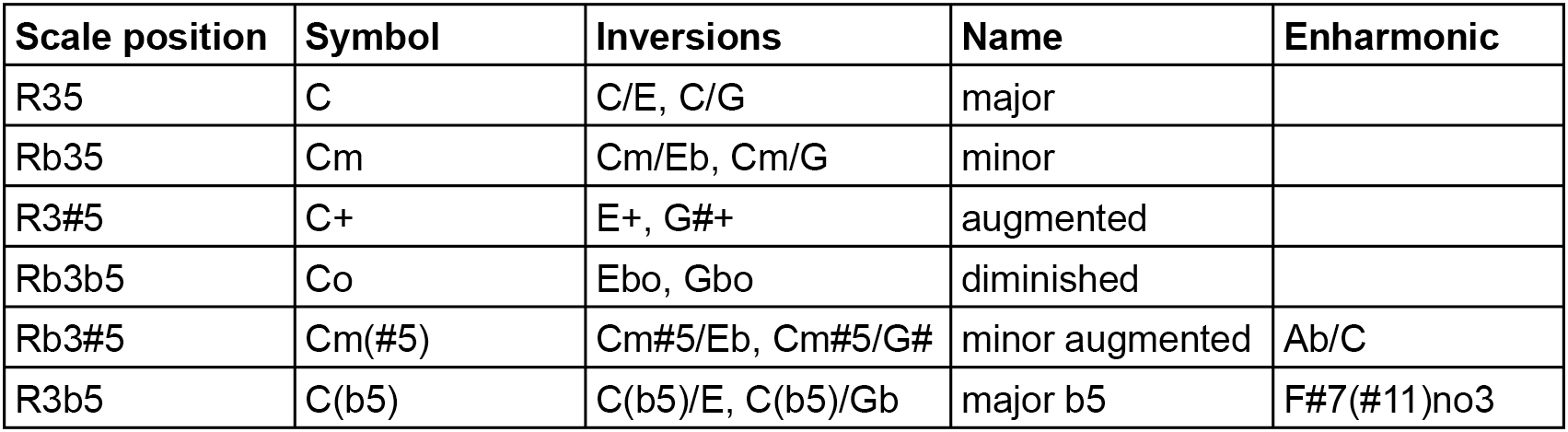
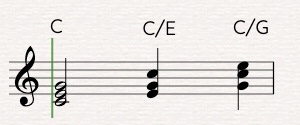
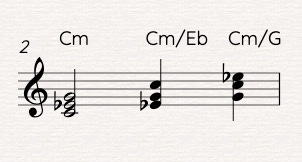
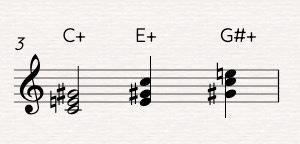
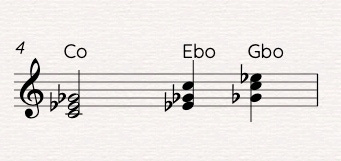
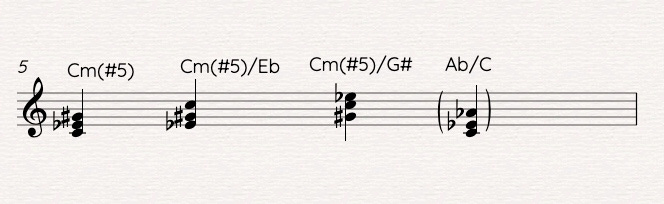
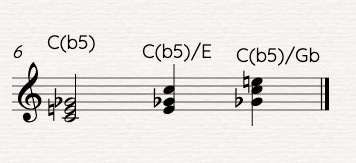
The letter on the left of the forward slash represents a C major triad (the abbreviation maj isn’t added as it always refers to the seventh). The letter to the right of the forward slash always indicates a single bass note. As a whole, the symbol C/E means a first inversion C major triad. The placement of root and third are left to the discretion of the accompanist unless there is a notated figure to be played.
The following Triad designations are listed in this order:
Scale position (R35)
Symbol (C, Cm, etc.)
Inversions (C/E, etc.)
R = root of chord and scale or mode. Numbers (3, 5, etc.) = the position of the pitch in chord and scale or mode in relation to root.
Next: Triads with suspensions
Copyright © 1993-2023 Jack DeSalvo