

Original Compositions
Poco a Poco

As much as I have an aversion to writing about myself, as some writers unconsciously primarily write about themselves with endless I(s) and me(s), I think it may be helpful to view the trajectory of my journey as someone who writes compositions for improvising musicians, a practice that is informed by jazz, classical music and folk music from all over the world.
I began writing Blues-Rock songs that I came up with for the garage band that I played with in 9th grade. Here in the U.S. that’s the first year of high school, though back when I was there it was the last year of Junior High School.
I started guitar lessons at eight year old but when I started classical guitar at 14, my teacher Leonid Bolotine sent me to the composer Ariadna Mikéshina for ear training, piano, theory and later composition and orchestration. I wrote piano pieces, chamber and symphonic music.
It was however the Jazz-Rock/Fusion revolution spearheaded by groups like The Mahavishnu Orchestra and Return to Forever that drew me into the sphere of jazz and improvised music. I moved backwards historically from Miles and Coltrane to Charlie Parker and then forward to the most modern, avant-garde stuff I could find. I also became, thanks to my various friend’s record collections, enamored of the then nascent ECM label.
Though I was accepted to Juilliard (for composition, the guitar department didn’t exist at the time) and Mannes College of Music (for classical guitar), I broke my classical teachers’ hearts and enrolled at the Berklee College of Music, one of the few jazz schools at that time.
While in Boston I began studying privately with the author of The Lydian Chromatic Concept, George Russell. We of course worked through his book, but he also showed me how to get my compositional ideas onto a chart that jazz musicians/improvisers could work with as well as how to be more flexible with my, at the time, more formal process of writing and preparing written music.
As I start to present my compositions we see that the earliest are from the 1970s and continue on through today. While there is much development of the work over that time there are also clear through lines and much consistency.
So from time to time I will post full compositions here for everyone, I will, in the (hopefully very) near future, post my entire catalog of thousands of pieces, little by little, decade by decade, for paid subscribers.
This first piece, Lucú, written in 1975 when I was 17, is the earliest I have in chart form. I can assure you that it wasn’t in chart form when I first wrote it. At the time I didn’t know what to call some of the chords, particularly the slash chords. It has a folky feel to it and I was probably thinking of the group Oregon when I wrote it.
You can download here:

Here is an image of the Lucú which you can download (above) as PDF :
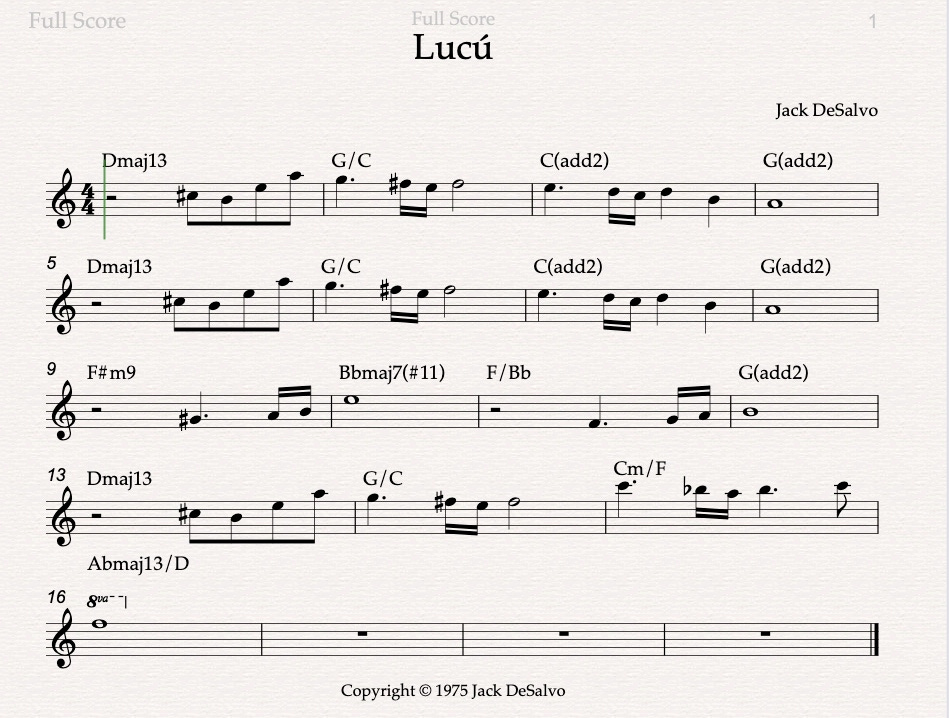
Here, harmonically we have a mix of “jazzy” chords and “folky” chords. Though a 19 bar piece may seem odd, it has a clear A A B A1 form. The seemingly missing measure right after Cm/F is an illusion because the first measure of the last 4 bars acts simultaneously as the last measure of the previous 4 bar phrase.
Another interesting feature is fourth intervals in the melody in bars 1, 5 and 13. Not surprising to see that come out because I was listening to McCoy Tyner’s Sahara and reading Stravinsky’s score for Le Sacre du Printemps.
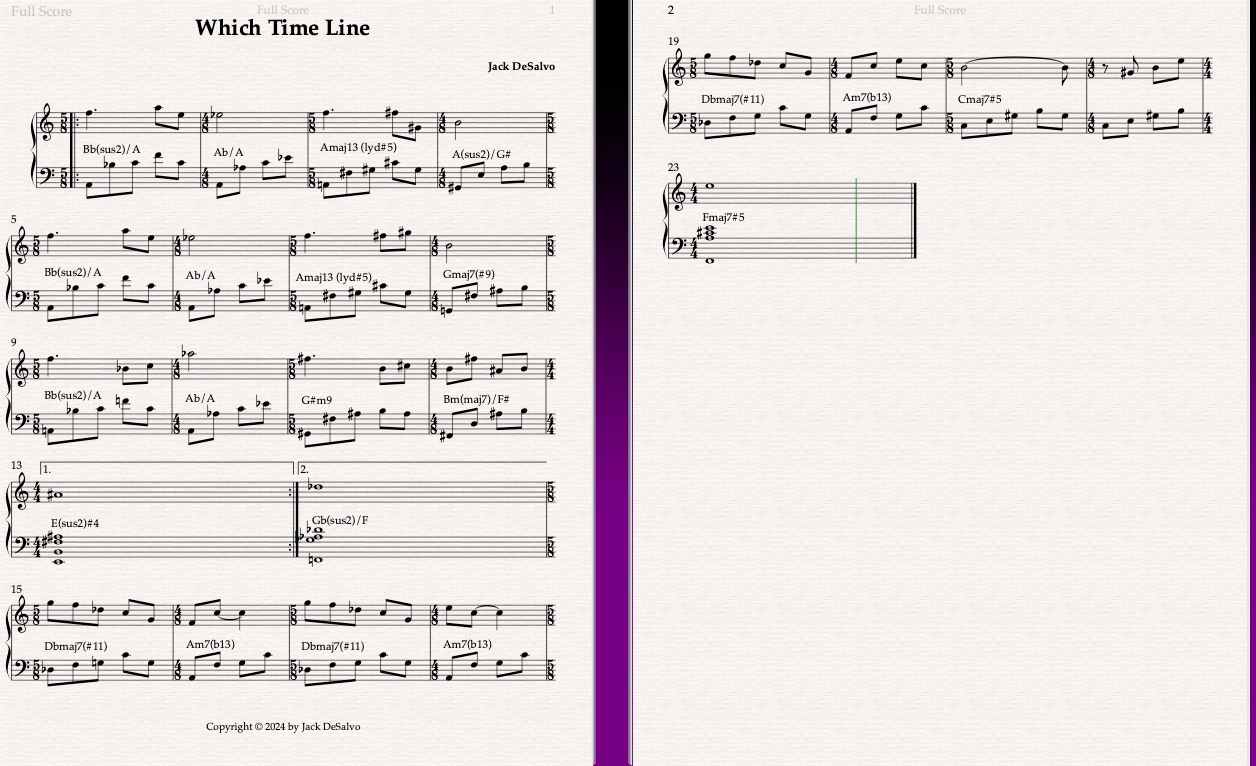
To contrast this here is a piece from 2024 called Which Timeline.
The PDF of Which Timeline is downloadable here:
And here is an image of the chart:
And also, here is a sound file of the piece as written on piano:
Though Which Time Line is clearly a much more complex piece than Lucú from almost a half century earlier, that won’t necessarily always be the case when juxtaposing early pieces of mine with more recent ones.
With Which Time Line we can see except for the 4/4 bars at the end of sections, to add a touch of breathing space, there are alternating measures of 5/8 and 4/8. Why not write it in 11 you ask? Several reasons, but the most important ones are phrasing of the melody and the harmonic nature of the arpeggios, which change every 5 eighth notes alternating with every 4.
Any harmonic ambiguity can be traced to the seemingly different sources for each bass note and the rest of the chord/arpeggio, but each chord, including the bass notes to the right of a slash (/) are traceable back to a single harmonic modal source. When the sources are viewed linearly (scalar) rather than horizontally (harmonically) these sources are heptatonic or symmetrical.
And yes, the improviser is expected to solo, or rather improvise over these changing harmonies and changing meters. We will discuss the specific harmonies next time.
As I always, for now, add to the end of these Substacks,