

The Process 1
A Composer's Beginnings

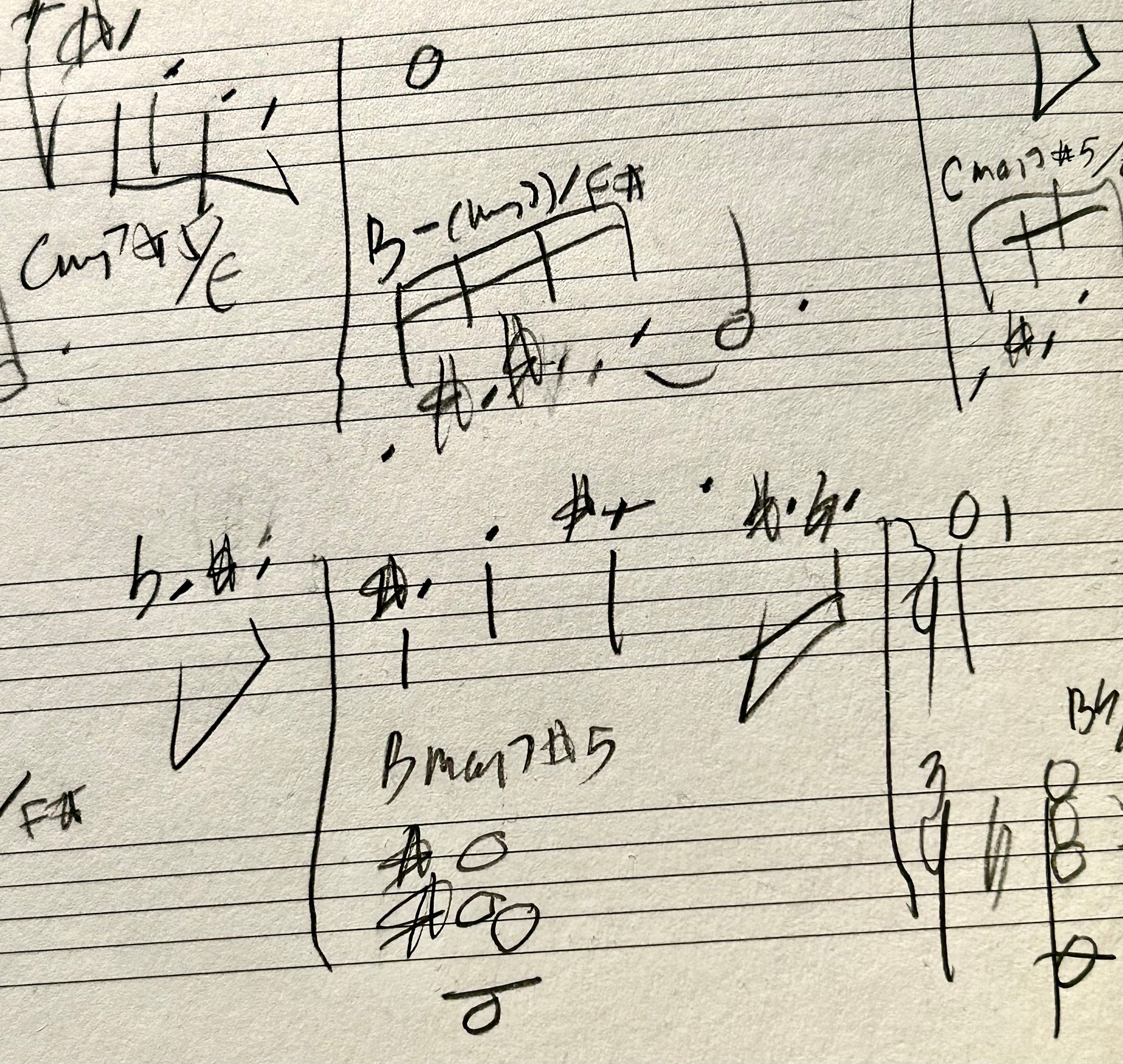
We all have our personal ways of writing. I started with a pencil on manuscript paper.
Well, not really.
As a child I copied the notes from my father’s handwritten notebook from when he studied saxophone. But actually I started making up songs on the guitar.
My friends and I started a band, truly a garage band, while still in junior high school. We had drums, two guitars and a singer. Wait a minute - no bass player? So the singer and I went to a music store and he bought a bass. I showed him the bass parts to the songs we played.
At the time it was a mix of Rolling Stones, Allman Brothers, Cream, etc. But I did create a few original songs in our set.
To be accurate, I didn’t really write the music on guitar, but rather I would imagine the music in my mind and then approximate it on guitar later and then show it to my bandmates.
I could read music a little bit due to my guitar lessons, but notation played no part in my nascent process.
The next year in high school the other guitar player moved on and we acquired a keyboard player and a new singer. Our former singer then focused on bass.
Our repertoire became more sophisticated, though the school dances we played required more pop fare. I was now studying classical guitar, but it was a completely separate activity.
Meanwhile my friends Steve Aprahamian (now a composer) and Bob Jenkins, a deep music aficionado, started to play me records by John McLaughlin and the Mahavishnu Orchestra and Chick Corea’s Return To Forever. I was entranced. Steve also had a live reel-to-reel recording of the all acoustic group Oregon that featured Ralph Towner on Classical guitar. I knew somehow in the future the classical guitar would figure in my music, even as an improviser.
My classical guitar teacher at the time, Leonid Bolotine, aware that I knew little of music theory, sent me to his sister-in-law, Ariadna Mikéshina, a composer who studied with Richard Stauss, to learn theory, ear training and piano.
As I progressed Madam Mikéshina began to teach me composition, of which orchestration was a big part.
So the idea of writing music became a very different thing. It was something you worked out on piano and wrote on music manuscript paper.
At the same time, still in high school, my journey into jazz evolved backwards from the 70s jazz-rock fusion at the time to late 60s Miles Davis, 60s post-bop, 50s cool jazz, Ornette Coleman’s free jazz and back to the 40s bebop of Charlie Parker and Dizzy Gillespie and around again to the most modern stuff I could find.
By the time I was a senior in High School I was far removed from the rock scene and putting together a fusion group with electric piano, bass, drum and electric guitar.
I wrote all the music for this band. Much to the band’s dismay, because of my training, I wrote the charts as if it was chamber music.
This is when I realized I was writing for improvisers. There were times where it was necessary to write detailed parts and other times when the music (and the musicians) benefitted from just melody and chord changes. Usually it turned out to be something in between.
To simplify the charts (not the music) visually, I consulted an old fakebook of my uncle’s. This book, though, was quite pre-Real Book and it often would have the symbol C for 4 bars when the recording of the song, at least a jazz version, seemed to have chords changing every measure, often two chords per measure.
The first year of college I studied classical guitar and started to gig with local funk and disco bands, observing the charts we used, though we were often expected to know the tunes before rehearsals.
The next year, to the disappointment of my classical teachers, I went to Berklee College of Music in Boston to study jazz. It was there that I encountered the original Real Book. After learning everything contained therein and from my private lessons with George Russell, my process of preparing written music of my compositions for improvisors was now ready to proceed, with constant developments as the years went on.
I finally felt comfortable notating my music in a way that served the music and the musicians.
Next we’ll look at some of my works from this early period when my focus had gone beyond fusion from when I was beginning to be influenced by great composers like Keith Jarrett and Ralph towner, who wrote with improvisers in mind.
I am planning on publishing all of my compositions here and much more content when, in the future, I institute paid subscriptions. Material will still be available for free subscribers, similar in scope to what I have already published.
Copyright © 2024 Jack DeSalvo
Super cool discovery stuff - and also a lovely autodidact story!
Nothing powers knowledge discovery skill and idealism like that fundamental spirit level (irrational, but post, rather than non) love for a subject, which goes so far beyond words into not just action - but a whole cascade of interlinked quests.
And McLaughlin and Corea - yowza! what an energizing double whammy!
Also - love the way you didn't just find what suited you and then insist it must also suit others (like some rather tantrum prone bandleaders I have known) but kept working to make your technique and expressions, ever more useful to the actual "as found" musicians around you (most of us learn better by modelling and encouragement than by conforming to strict doctrine, anyhow).
A mark of someone truly dedicated to the pursuit itself and interested in the world, and not just seeking the embiggening of their own ego!
Also love your genre journey. I was raised on classical and folk (dad was a pro church organist at the age of 14) then rebelled into old jazz in my teens, when everyone around me was into commercial crap-rock. Only discovered high technique prog and fine songwriting classic rock many years later, thanks to a rock and roll pal who was improvising with my bebop mentor and I, and simultaneously deep studying bluegrass, as a whole new motherlode of guitar techniqe that his cover band gigging years never taught him.
I think some people think about musicians as being very much concentrated in the area for which they are known (same for writers, definitely). But in my experience, the most interesting creators are almost always those who are voracious and cultural polyglots, rather than the hyper specialized and obsessed (of course with some noteworthy exceptions - there really are some who do well in an attic!)
Cheers man - clueful and sincere - thank you for it!
¯\_(ツ)_/¯