

The Process 1.1
Lucú: Writing an Early Piece

I started with four chords on the piano. I used 4 voice chords that I hoped would transfer easily to guitar.
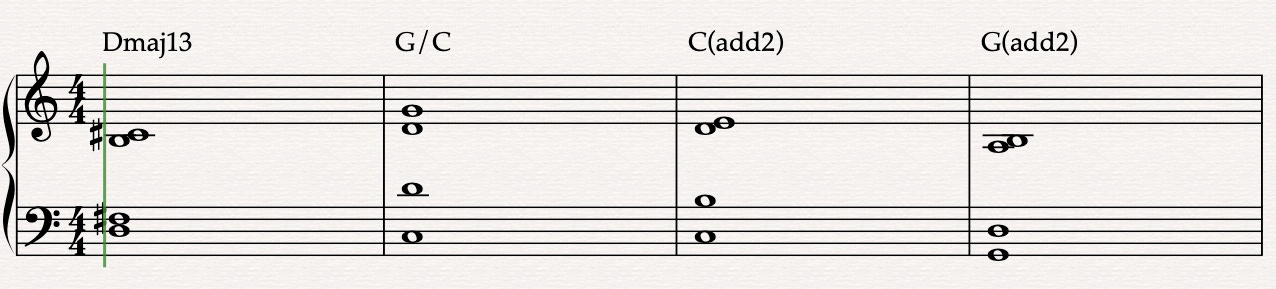
And the same chords for guitar:

Dmaj13 G/C C(add2) G(add2)
How is a Dmaj13 a 4 note voicing? D4, F# a major 3rd above that, B a 4th above the F# and C# a whole step above the B. I’ve seen it written as Dmaj7/6, but there’s no such thing since when a 7 is present the 2, 4 and 6 are pushed to the next octave as 9, 11 and 13 regardless of voicing.
Also the 5th is omitted and the 9 and 11 are not implied. If they’re there, they need to be mentioned, as in Dmaj9,#11,13.
This is one of the first pieces I wrote in fakebook style, or these days we would say Real Book style. One line of melody with the chord names above each measure. On the chart I didn’t even have the voicings specified.
Though I had not yet seen the Real Book, neither had most other musicians. I assumed at the time that other players would be familiar with things like slash chords [G/C]. But this was this was not the case as Lucú was written when I was still a teenager in 1970s so everything needed to be verbally explained. By the 70s certain fakebooks technically used slash chord symbols , but almost always depicting inversions of basic chords, G/B, etc.
While trying to decipher the quartal chords I heard pianist McCoy Tyner playing on John Coltrane records and especially on his own album Sahara, as well as in Stravinsky’s Le Sacre du Printemps, I didn’t know what to call the chords as I didn’t have a diatonic context from which to place them. Though in McCoy’s case it was clear that his often 3 note voicings seems to come from the shifting single-note pentatonic patterns that he used with his right hand, it was still unclear what to call these voicings.
I also heard slash chords - mostly triads with a non-chord tone in the bass - on recordings as diverse as John McLaughlin’s My Goals Beyond, any Oregon album and Keith Jarrett’s Facing You.
A book appeared that presented musical scores of McLaughlin’s compositions from Mahavishnu Orchestra recordings as well as showing what he called synthetic scales from which his chords where derived. thankfully the chords in the compositions were named; an A major triad with its 4th in the bass was written A/D, with its second in the bass, A/B, etc.
I became driven to find and literature on unique chords and one of the most important books I found was Vincent Persichetti’s Twentieth Century Harmony. It outlines and defines many harmonic shapes including slash chords, polychords, added-note chords, sus2 and sus4 chords and explains their modal origins.
As we will see, this piece, Lucú, seems to have a very traditional form, A A B A1 tag, and as tame as it may appear now, at the time it did not.
For the second 4 bars I repeated the first 4 by which time I began the hear the melody in my head which, considering it’s a fairly simple folk-like melody, I was able to notate without the aid of a piano or guitar.
Measures 9-12 represent a bridge, thought this time I wrote the melody first and then chose chords to fit it.

Generally, though not always at the time I would voice down a chord using the longest melody note as the highest voice.
For what I thought would be the final 4 bars, something instinctual happened that did a number of things, including creating an asymmetrical form.
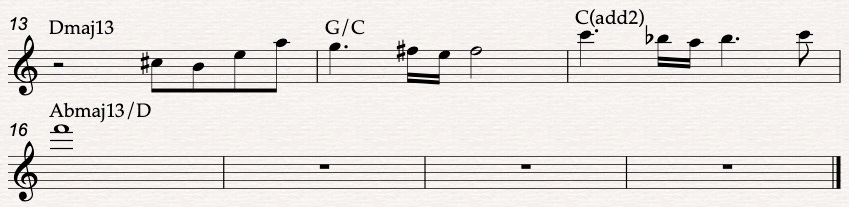
I thought I would just restate both chords and melody from the first 4 bars, but the melody took on its own trajectory that caused me to expand the fourth bar into 4 bars. The final pitch a high F, implied a new harmony and as a painter steps back to see the macrocosm of their work, I saw that these additional measures of a single chord gave not only breath and space to the piece but also its own natural shape, transcending the initial 4 bar phrases.
Here is a downloadable PDF of Lucú:

Next we will continue examining the process of writing music for improvisers with a look at some of my work from the 80s.
I am planning on publishing all of my compositions here and much more content when, in the future, I institute paid subscriptions. Material will still be available for free subscribers, similar in scope to what I have already published.
Copyright © 2024 Jack DeSalvo