

Upper Voices
and the First Four Heptatonic Systems from the Harmonic Continuum

We spoke earlier of the Harmonic Continuum. In its purest form the Harmonic Continuum is the overtone series. Without repeating notes in higher octaves and adjusting for equal temperament, the first seven tones from the overtone series gives us this arpeggio: R,3,5,b7,9,#11 and 13.
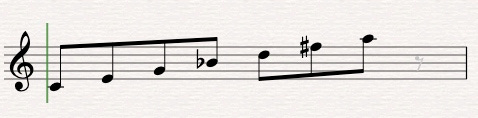
This is also the arpeggio derived from the fourth mode of the Melodic Minor scale, if arranged in a series of ascending thirds.
Interestingly, if we follow the Undertone series down, with similar adjustments, starting on C, by the time we reach the seventh differentiated note (not the same note regardless of octave), which is E, we have an F Melodic Minor scale.
These seven notes from the Undertone series would be: 5,R,b3,6,4,2,7
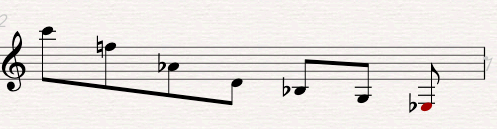
In ascending thirds from F (as the root of F Harmonic Minor) we have R,b3,5,7,9,11,13

Seven note scales and modes, when placed in a ascending thirds, mirror the trajectory of the overtone series, even if their intervallic patterns vary from it.
If we take a mode, using Dorian for example here, and look at it and listen to it in a series of ascending thirds we see where upper voices come from every other note in the mode - 2, 4 and 6 become 9, 11 and 13.
Dorian mode: R,2,b3,4,5,6,b7
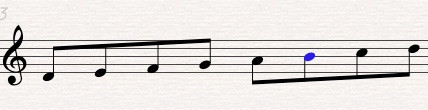
Looking at it in thirds we see the first three notes create a minor arpeggio. If they are played simultaneously they are a minor triad, so it is possible to also look at the upper voices of chords/arpeggiated modes as upper-structure triads. These match the triads built from the root of the mode built on the next scale tone. This means the upper voices (9,11,13) from a D Dorian mode (E,G,B) are identical to the the triad built on the root of the E Phrygian Mode (Em).
So a Dm7,9,11,13 can also be conceived of as a polychord:
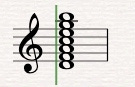
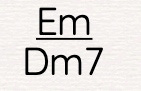
We will look more at the concept of adding various triads as the upper-structure of seventh chords when we delve into more exotic Heptatonic systems.
The first four notes give us a minor seventh (m7) arpeggio/chord.
R,b3,5,b7
Five notes in thirds from the root is a minor ninth (m9) arpeggio/chord.
R,b3,5,b7,9
Six notes, minor eleventh (m11)...
R,b3,5,b7,9,11
All seven give us a minor thirteenth (m13).
R,b3,5,b7,9,11,13
Because the improvising accompanist often will voice a chord sparsely to imply certain harmonies it’s possible that, for example, a Dm13 may be voiced, in ascending order, C,F,B, which is b7,b3,13. If it’s necessary to have the entire harmony played, the full symbol Dm9,11,13 should be used, keeping in mind that certain instruments, including guitar and vibes, will have to arpeggiate the chord to some extent to effectively sound all seven tones.
Heptatonic Systems
We will start by first talking about the first four Heptatonic Systems and then later look at the others.
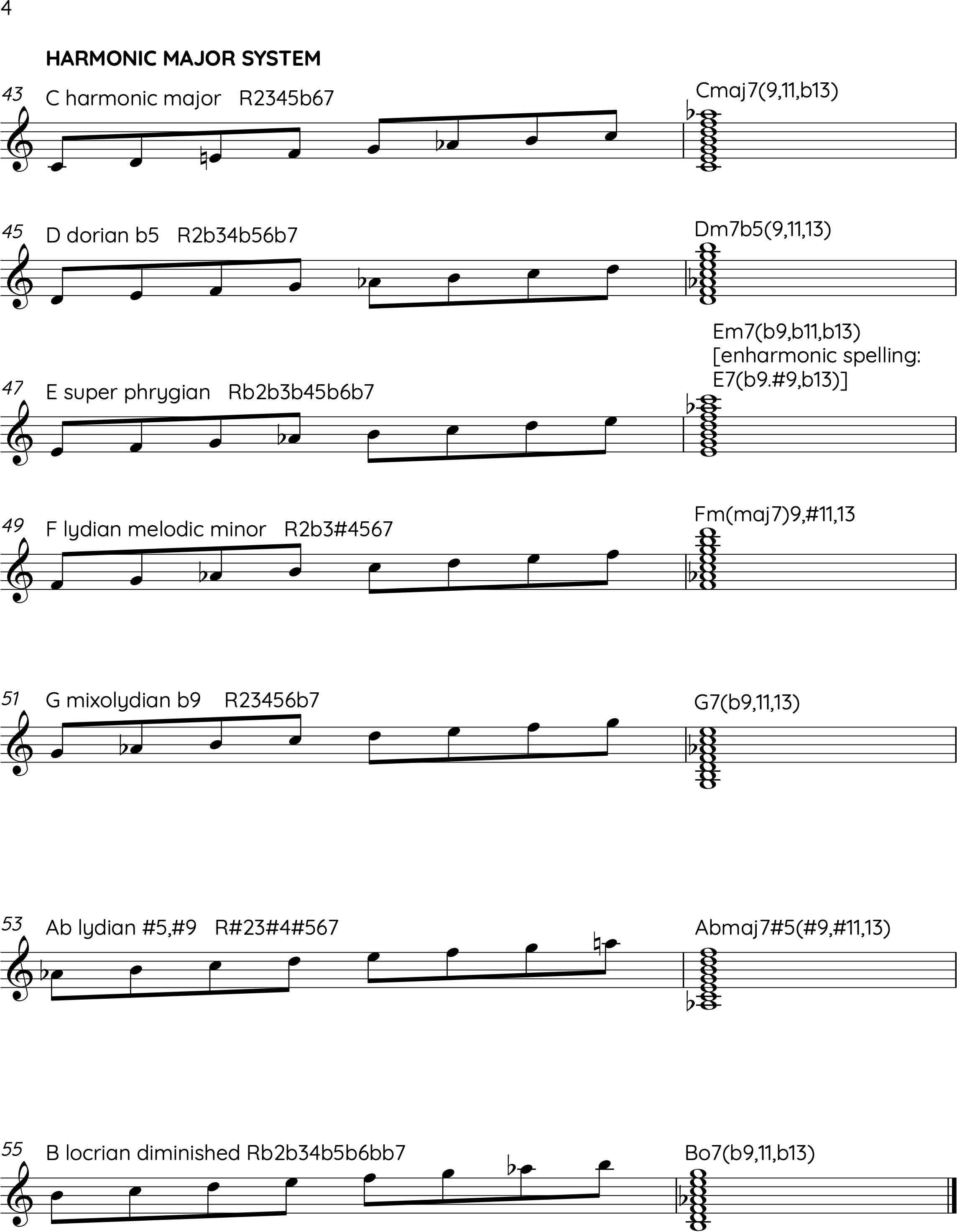
There are 33 Heptatonic Systems. This means there are 33 scales with a mode built on every scale degree leading to 231 different seven note modes without any interval greater than an augmented second between adjacent scale degrees. This also means there are also 231 chords containing some kind of triad, some kind of seventh chord and some kind of upper voices (altered or unaltered 9,11 an d 13) and of course myriad other combinations of tones from these modes.
We will start by first talking about the first four Heptatonic Systems and then later look at the others.

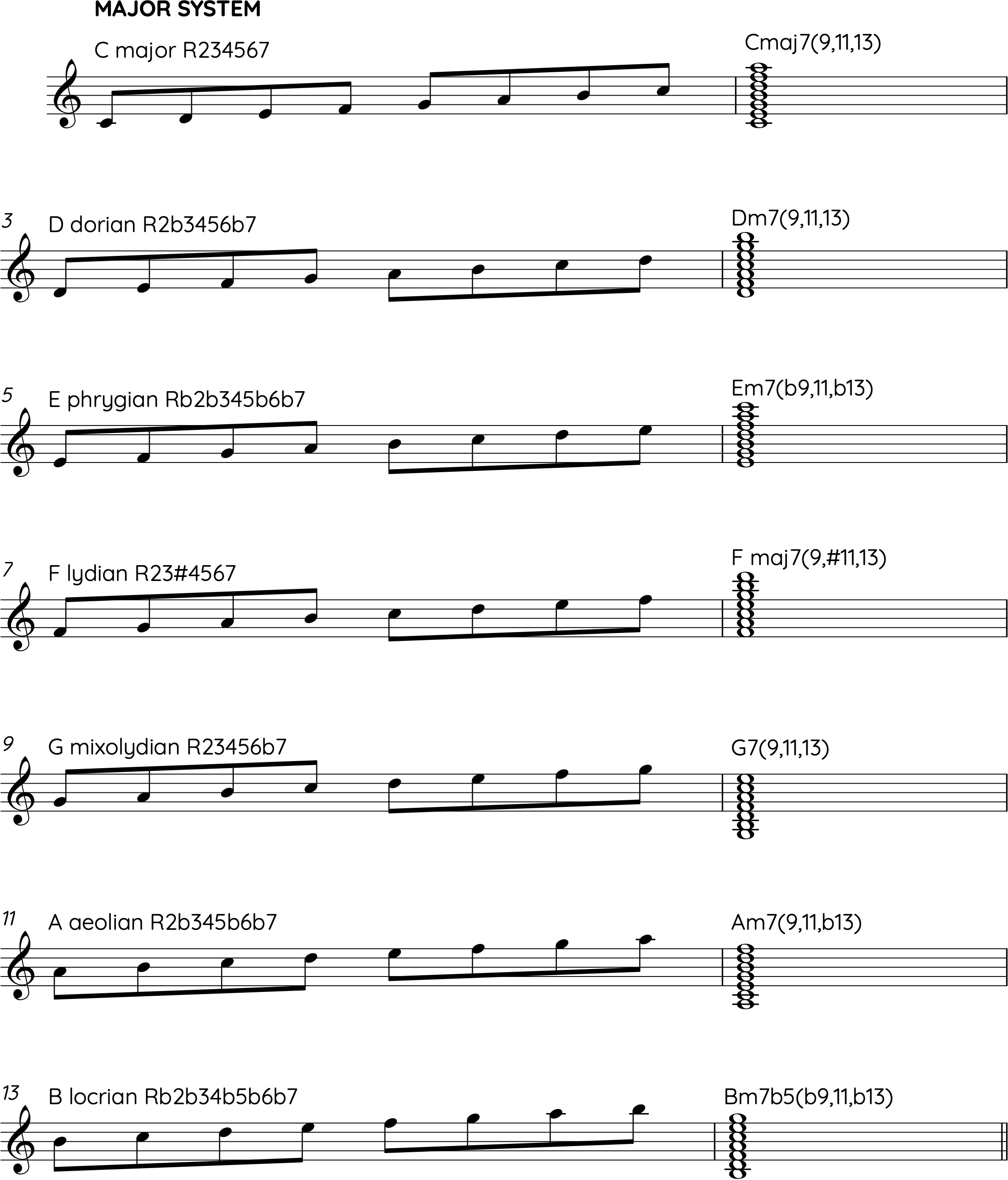
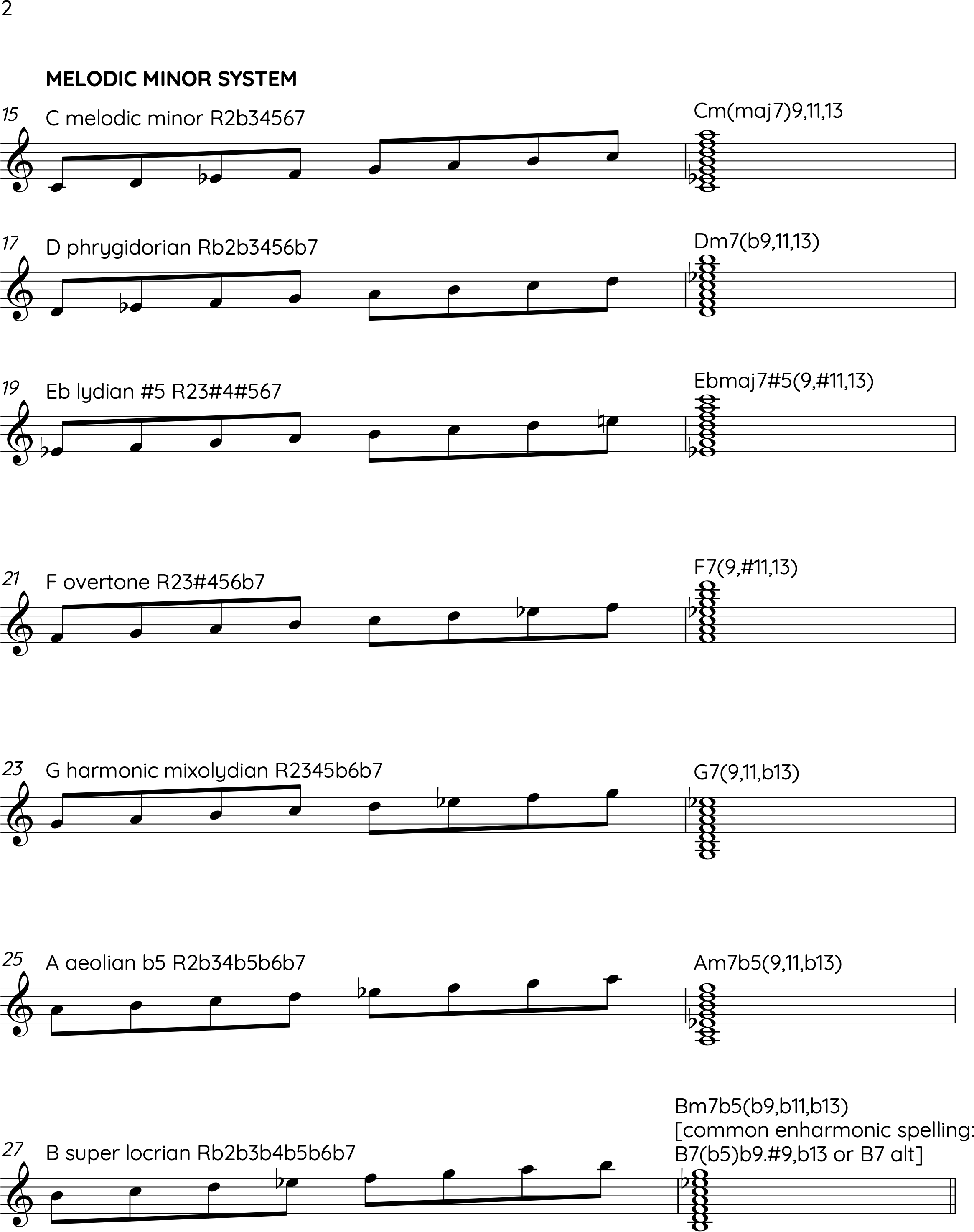
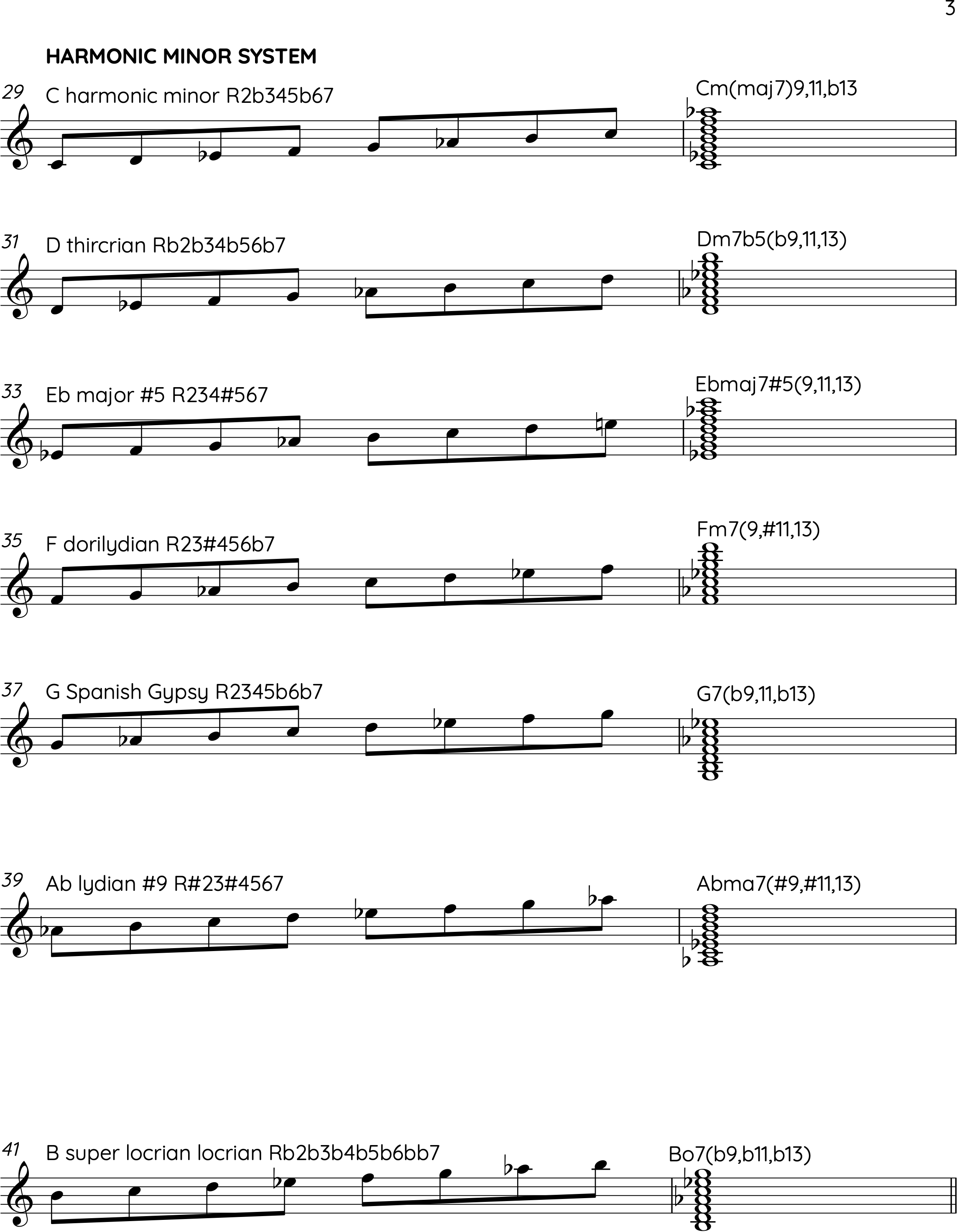
Next: We view the structure of these Heptatonic Systems in even more detail and introduce Symmetrical Scales.
Copyright © 1993-2023 Jack DeSalvo